Wicca: The Religion of Witches, Festivals & Rituals
In this article, I wish to bring you a little closer to the Wicca cult. It is a nature religion that is officially recognized in the USA and arguably the largest group within Neopaganism. Its members understand themselves as Witches, and the name “Wicca” essentially translates to “The Religion of Witches.” One could write entire libraries on this subject, but I have gathered the most essential points for you here.
From Gerald Gardner to the Primal Religion: The Roots
Writing about and researching the origins of Wicca is difficult, as there are many conflicting views. However, the consensus is that it attempts to reconstruct a primal religion born from pagan beliefs.
In 1921, the British anthropologist Margaret Murray wrote about the wise women of Europe in her influential work. She described “witchcraft” not as devil worship, but as a magical and religious cult that had existed for ages, standing in constant opposition to Christianity.
The Modern Founding The modern Wicca religion as we know it today was likely founded by Gerald Brousseau Gardner. He claimed to have been initiated into an existing coven, the New Forest Coven. Today, there are distinct lineages, such as the Alexandrian or Gardnerian traditions. Added to this are the “Solitary Practitioners” (what I call “free-flying witches”) and modern Neo-Wicca, which has spread rapidly since the 1980s.
Etymology The word Wicca comes from Old English (Anglo-Saxon) and originally meant “soothsayer” or “sorcerer” (male). Wicce was the female form. From these roots, we derive the modern English word Witch.
The Circle of 13: Community, Ritual & Magic
What is a Coven? Most traditional Wiccans join a Coven. No two covens are exactly alike; they have different views and traditions. You will find blends of Celtic, Egyptian, Native American, and syncretic beliefs.
Structure: A coven usually consists of 13 people, as the number 13 is considered magical in this movement. There is typically a High Priestess, often a High Priest, and a “Maiden”—the deputy of the High Priestess.
Meetings: The coven meets for the eight festivals of the Wheel of the Year and at the Full Moon.
Clothing: Some covens practice “skyclad” (naked), others require specific robes, and some allow ordinary street clothes.
Expansion: Tradition dictates that if a coven becomes too large, a new one must be formed—often required to be at least 3 miles (approx. 5 km) away from the mother coven (the “Hive Off”).
The Triple Goddess & The Horned God
What does Wicca believe? The core belief is that everything is a unity—interconnected and woven together. Nature is viewed as holy because it provides humans with physical and spiritual strength.
At the center stand The Triple Moon Goddess and The Horned God.
The Goddess: She appears as the Maiden, the Mother, and the Crone (The Wise One).
The God: He is often personified as the Green Man, the Sun God, or the Father Sky.
In rituals, practitioners often work with specific deity names, which are seen as aspects or “masks” of the two main primal forces. It is comparable to Hinduism. Every Wiccan chooses the deities they can identify with most. It is always a divine pair, for example:
Aradia & Cernunnos
Freyja & Odin
Diana & Pan
Lilith & Samael
Isis & Osiris
Shakti & Shiva
In this Old Religion, the female Goddess and the male God are equals. However, there are also Wiccans who do not worship personified deities but practice a direct union with nature. Many Wiccans see their intellectual “ancestors” in Freemasonry and Rosicrucianism, with Alchemy and Ceremonial Magic playing a significant role.
The Law of Return: Karma, Ethics & Freedom
Wicca is a peaceful religion. It is joyful and lustrous, living in the Here and Now, rather than seeking salvation only in the afterlife. The body and nature are sacred, not sinful.
Reincarnation There is a belief in the rebirth of the soul. However, unlike Hinduism, Wiccans generally do not believe that one is punished in this life for the sins of a past life. The soul is free, and you bear responsibility for your own life.
The Wiccan Rede Wicca rejects fanaticism. They live by a central ethical guideline:
“An it harm none,
do what ye will.”
(As long as it harms no one, do what you want).
The Rule of Three
“Ever mind the Rule of Three.
Three times what thou givest returns to thee.”
(Everything you send out—good or bad—comes back to you threefold).
 The Wheel of the Year: Sabbats & Esbats
The holidays of the Wicca cult are based on their Wheel of the Year. This wheel consists of four Celtic Fire Festivals and four Solar Festivals. In Wicca, these eight festivals are called Sabbats.
Historical Note: I must note here that the ancient Celts (especially those on the Isles) likely only celebrated the four main Fire Festivals. The Solstices and Equinoxes were incorporated later, largely from Germanic and Megalithic traditions.
The Greater Sabbats (Fire/Moon Festivals):
Samhain (The Celtic New Year)
Imbolc
Beltane
Lughnasadh (Lammas)
The Lesser Sabbats (Sun Festivals):
Litha (Summer Solstice)
Yule (Winter Solstice)
Ostara (Spring Equinox)
Mabon (Autumn Equinox)
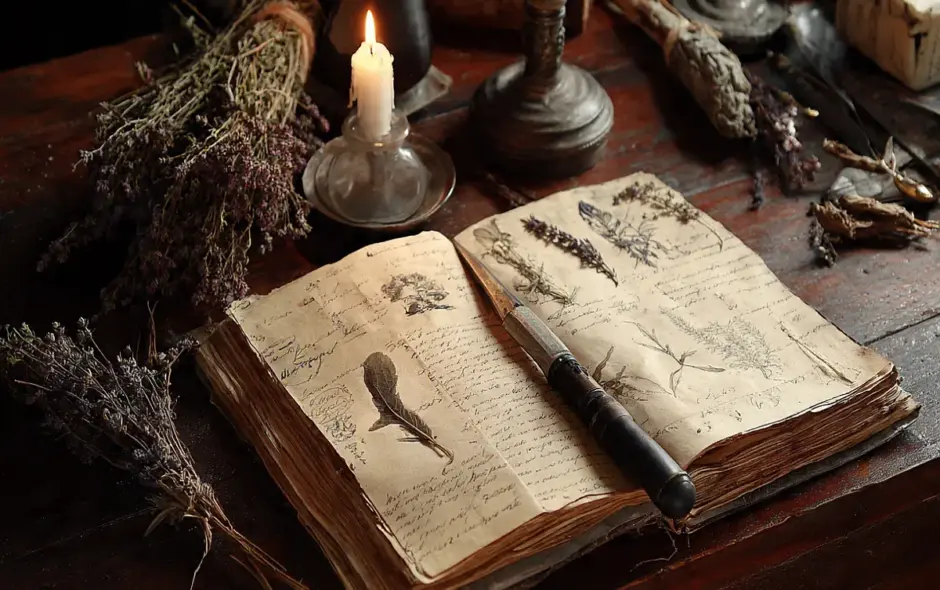
In addition, there are festivals to honor the Full Moon, known as Esbats. Every coven possesses a Book of Shadows, where rituals, invocations, and secret knowledge are recorded.
A Personal Word: Boundaries & Respect
Before the questions flood my inbox: No, I do not belong to the Wicca religion.
Furthermore, I personally dislike the word “Witch.” To me, it is a term heavily burdened with negativity, an invention of the late medieval Church used to persecute the innocent. So many women and men lost their lives in the flames because of this label. I find it disrespectful to call oneself a “Witch” today as a fashion statement. To me, it feels like a mockery of those who suffered and died in agony back then. I am a researcher of the Old Ways, a gardener, and a keeper of lore—but I do not claim a title that was once a death sentence.